Annual Reports
Maximus, Inc.'s annual reports contain management's most considered account of the business. These are the sections, passages and visual pages worth opening in the originals preserved in Sources.
Maximus, Inc. — FY2025 Annual Report (Form 10-K) — FY2025
Latest 10-K; the fullest account of how a government-services contractor earns, where its revenue concentrates, and the policy/budget risks that could bite. · Open the full document →
Item 1. Business — General — p. 8 · Read the full section →
The core self-definition: a tech-enabled services provider that turns public policy into operating models delivered at scale.
What Maximus is and how it says it creates value.
Maximus, a Virginia corporation established in 1975 and celebrating its 50th anniversary this year, is a leading provider of tech-enabled services to government agencies. […] We create value for our customers through our ability to translate public policy into operating models that achieve outcomes for governments at scale.
p. 8 · Read in context →
Item 1. Business — Our Business Segments — p. 9 · Read the full section →
Defines the three operating segments and the revenue concentration — U.S. Federal Services alone is 56% of the top line.
Three segments; U.S. Federal Services is the majority of revenue.
We operate our business through three segments: U.S. Federal Services, U.S. Services, and Outside the U.S. We operate in the United States and worldwide. […] Our U.S. Federal Services Segment generated 56% of our total revenue in fiscal year 2025.
p. 9 · Read in context →
Item 1A. Risk Factors — p. 22 · Read the full section →
The two risks specific to this business model: dependence on government appropriations/shutdowns, and cyber breaches of the citizen data it holds.
Custodian of citizen and health data — a breach threatens contracts, sanctions and client confidence.
The risk of a security breach, system disruption, ransom-ware attack, or similar cyber-attack or intrusion, including by computer hackers, cyber terrorists, or foreign governments, is persistent, substantial, and increases as the volume, intensity, and sophistication of attempted attacks, intrusions and threats from around the world increase daily. […] The loss, theft, or improper disclosure of that information could subject us to sanctions under the relevant laws, breach of contract claims, contract termination, class action, or individual lawsuits from affected parties, negative press articles, reputational damage, and a loss of confidence from our government clients, all of which could adversely affect our existing business, future opportunities, and financial condition.
p. 29 · Read in context →
Item 1C. Cybersecurity — p. 41 · Read the full section →
Discloses the FY2023 MOVEit incident as a material event — the concrete instance of the breach risk, with governance detail.
The material FY2023 incident: a zero-day in a third-party file-transfer vendor exposed personal data.
We have experienced cybersecurity incidents that were immaterial and, as previously disclosed, in the third quarter of fisca year 2023, we experienced a material cybersecurity incident as the personal information of a significant number of individuals was accessed by an unauthorized third-party exploiting a zero-day vulnerability in a third-party vendor's file transfer application used by many organizations, including us.
p. 41 · Read in context →
Item 7. MD&A — Results of Operations — p. 49 · Read the full section →
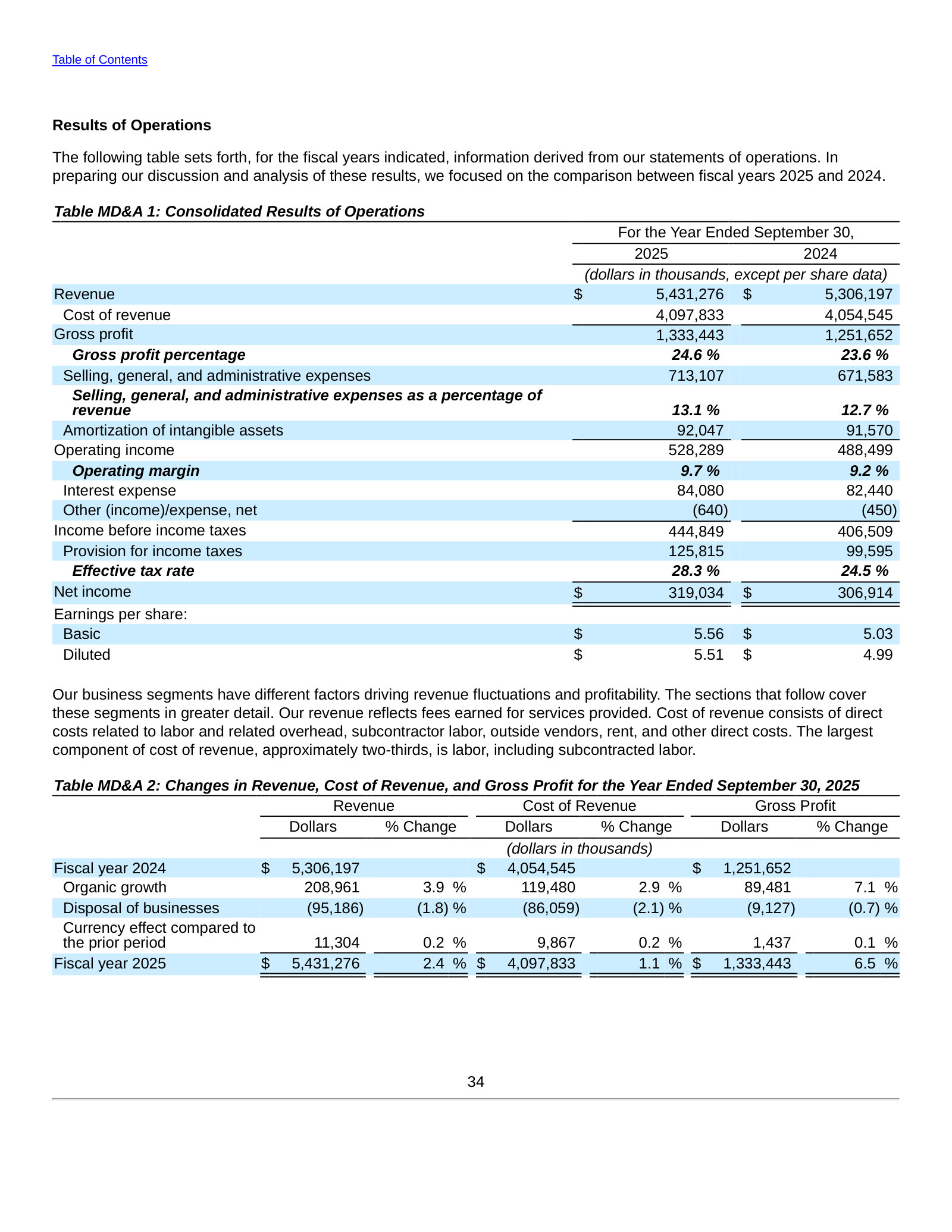
The consolidated P&L plus a revenue bridge that separates organic growth from the Outside-U.S. divestitures and FX.
Item 7. MD&A — U.S. Federal Services Segment — p. 51 · Read the full section →
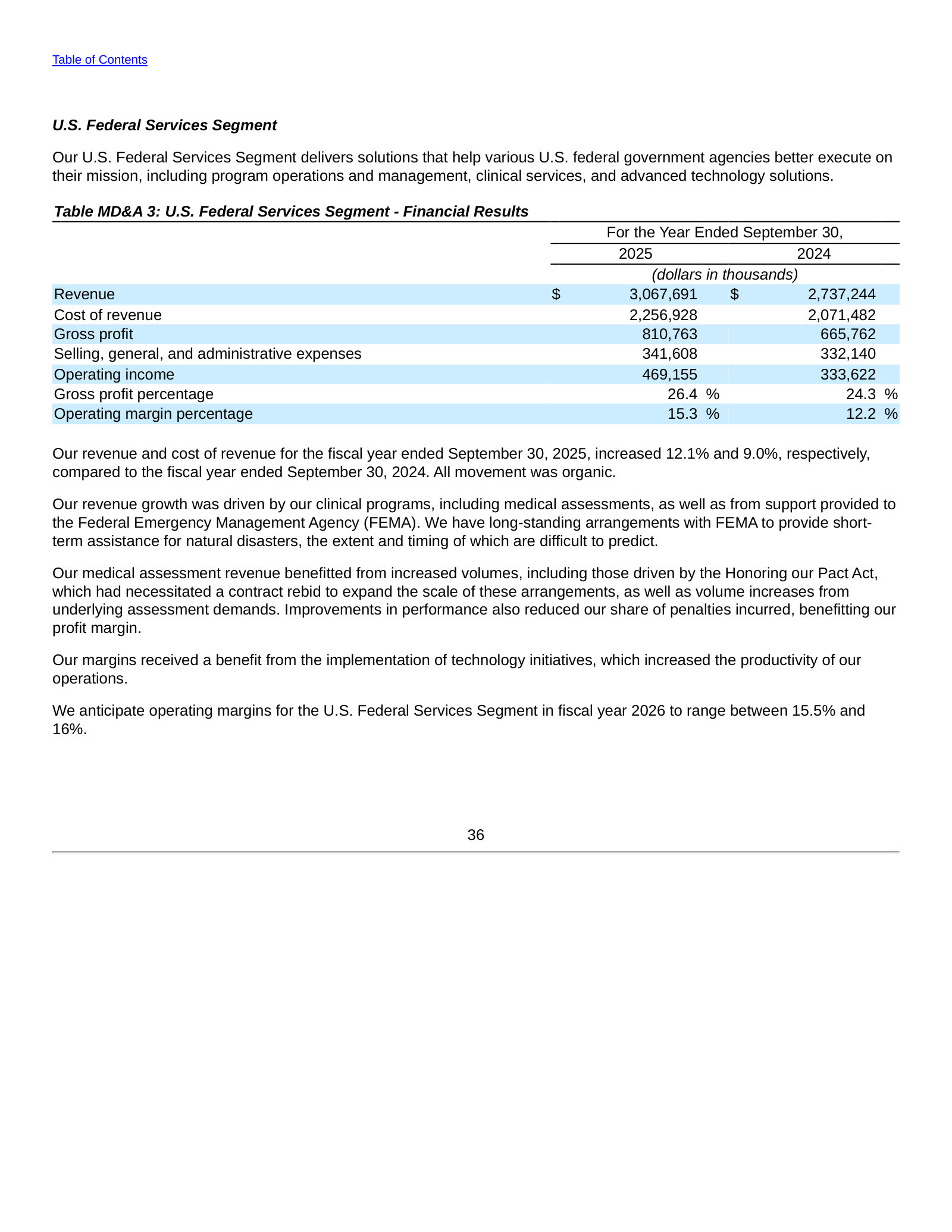
Management's own account of what drove the year: clinical/medical assessments, the PACT Act, and FEMA disaster support lifting margin to 15.3%.
The growth drivers: clinical programs, FEMA support and PACT Act–driven assessment volumes.
Our revenue growth was driven by our clinical programs, including medical assessments, as well as from support provided to the Federal Emergency Management Agency (FEMA). […] Our medical assessment revenue benefitted from increased volumes, including those driven by the Honoring our Pact Act, which had necessitated a contract rebid to expand the scale of these arrangements, as well as volume increases from underlying assessment demands.
p. 51 · Read in context →
Item 7. MD&A — Backlog — p. 54 · Read the full section →
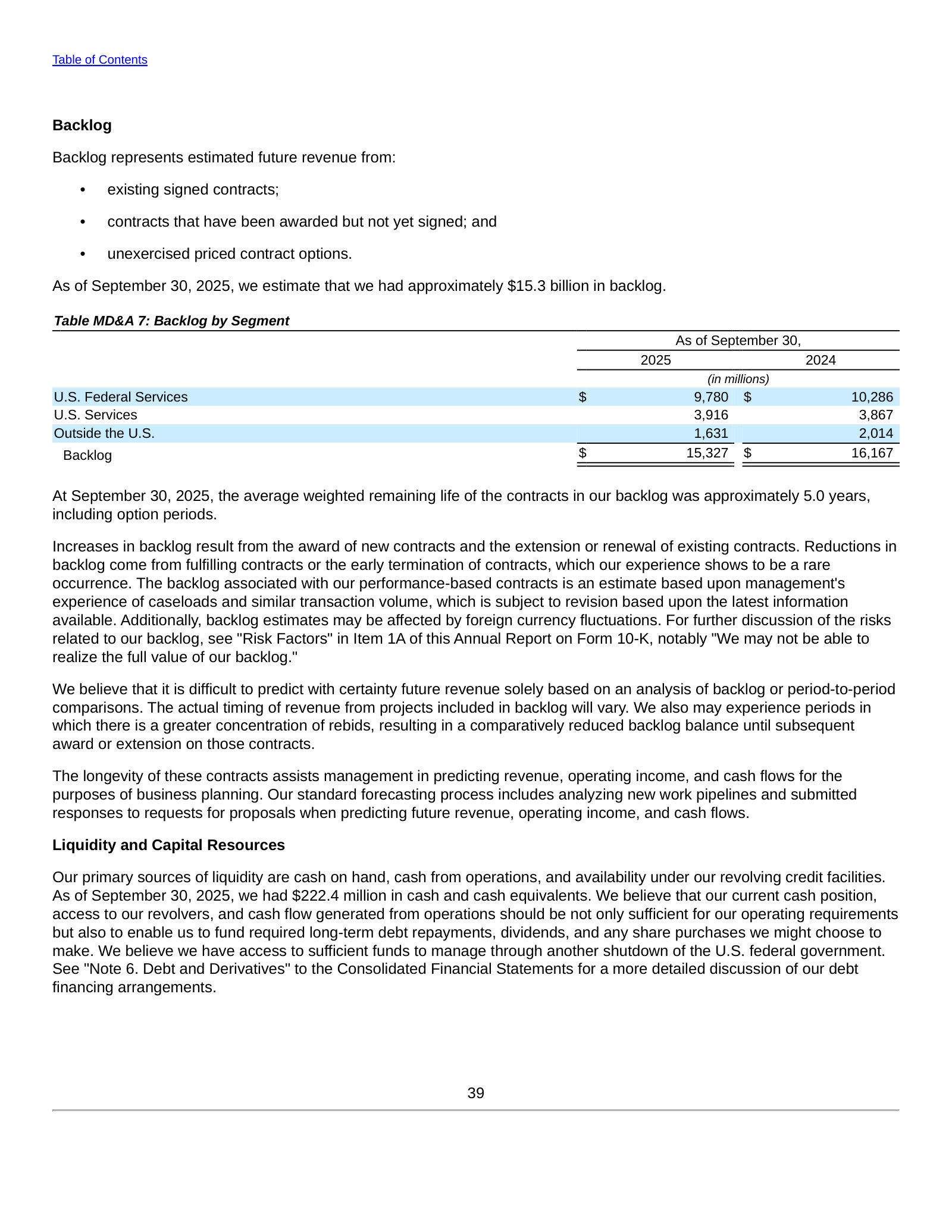
Revenue visibility for a contractor: $15.3bn of backlog with a ~5.0-year weighted remaining life, split by segment.
Item 7. MD&A — Free Cash Flow and Credit Facilities — p. 56 · Read the full section →
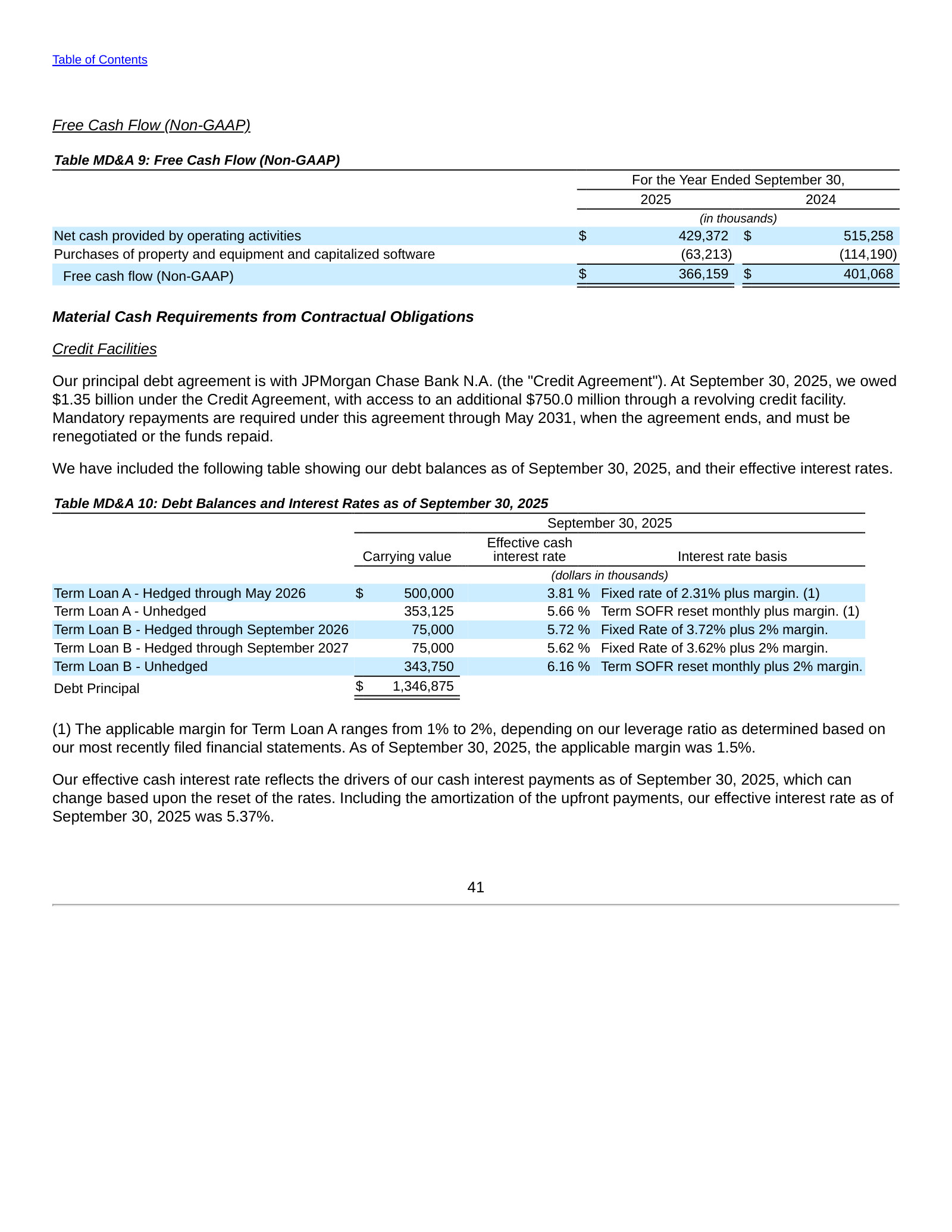
The non-GAAP free-cash-flow reconciliation and the $1.35bn term-loan schedule that debt reduction is prioritized against.
Critical Accounting Policies — Revenue Recognition — p. 59 · Read the full section →
The policy that defines the model: performance-based contracts carry variable consideration estimated by expected value and constrained against reversal.
Penalties and incentives are variable consideration, estimated and constrained each period.
Certain performance-based contracts include variable consideration in the form of penalties and incentives, based on our performance under the terms of the contract. The calculation of these penalties and incentives requires the evaluation of both objective and subjective criteria, which may require the use of estimates. […] We estimate the total variable consideration we will receive using the expected value method. […] We are required to constrain our estimates to the extent that it is probable that there will not be a significant reversal of cumulative revenue when the uncertainty is resolved.
p. 59 · Read in context →
More annual reports
Maximus, Inc. — FY2024 Annual Report (Form 10-K) — FY2024 · 117 pages · The prior year's baseline for the FY2025 comparisons — revenue $5.31bn and the segment mix before further Outside-U.S. divestitures. · Open →
Maximus, Inc. — FY2023 Annual Report (Form 10-K) — FY2023 · 114 pages · First disclosure of the MOVEit cybersecurity incident and the start of the Outside-U.S. reshaping/divestiture program. · Open →
Maximus, Inc. — FY2022 Annual Report (Form 10-K) — FY2022 · 119 pages · The pre-divestiture Outside-U.S. footprint and peak pandemic-response work, useful as an evolution reference. · Open →
Maximus, Inc. — FY2021 Annual Report (Form 10-K) — FY2021 · 124 pages · The earliest edition on the shelf — segment structure and disclosures before the recent strategy reset. · Open →